Swindon & Wiltshire News

Demand for solar energy from the business sector in the South West goes through the roof, says installer Solarsense
Demand for solar energy from the business sector in the South West is going through the roof, according to solar panel installer Solarsense.
The Bristol-based firm has reported a 172 per cent increase in commercial enquiries from the South West during 2022, as soaring energy bills lead businesses to look seriously at on-site solar energy generation.
The increase in demand has been mostly driven by large-scale energy users including the manufacturing, telecommunications and data centres, food and beverage, warehousing and distribution sectors.
In total, Solarsense is working on 200 new commercial enquiries across the South West region which could generate an estimated 40 megawatts of clean energy between them. This represents a tenfold increase in enquiries in the past five years.
Before the introduction of the Energy Bill Relief Scheme in October, large users of energy in the South West had seen costs skyrocket to 45-65p per unit, a circa 350 per cent increase over the last year alone.
Solar energy, in contrast, typically costs around 4p/kWh, taking into account capital outlay and generation over 20 years, and provides long-term energy security.
Solarsense managing director Stephen Barrett said: “We’ve been in the solar industry for more than 25 years and the current level of enquiries is unprecedented.
“The efficiency of solar panels has dramatically improved in the last few years and when combined with the huge reduction in installation costs and increase in energy prices, the financial returns are extremely attractive.
“We are now seeing payback periods for the technology as low as between two and five years which would have been unthinkable just a few years ago – we were looking at payback periods of 100 years when we first started in the industry.
“We’re also finding that businesses which already have panels on south-facing roofs are coming back to us as now east/west or even north-facing aspects may be viable, given the energy crisis and high costs of energy from the grid.
“Not only is making the transition to renewable sources of energy good for the balance sheet, it is also essential to enable the South West to move away from fossil fuels and towards a greener, more stable, energy future. I think the take-up of solar energy will continue to grow strongly in the region in 2023.”
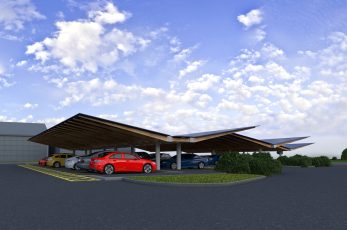
Among the businesses to invest in new solar technology in 2022 was high-performance plastic precision engineering business Nylaplas Engineering (pictured) which has installed a 114kWp solar panel system at its high-technology manufacturing site in Bristol.
Nylaplas managing director, Chris Eastman, said: “As a leading engineering company specialising in the precision manufacturing of plastic components for a range of industries, we use a vast amount of electricity for our day-to-day operations.
“Reducing our impact on the environment and sustainability is really important to us and to deliver overall cost savings over the lifetime of the project was a win-win for the organisation.
“Installing solar energy was a huge step in our environmental journey and will allow us to reduce our reliance on fossil fuels in the future.”
There has also been a growing move towards onsite renewable energy generation among local authority services in the South West during 2022.
Easton Swimming Pool in Bristol reduced its bills to zero this summer thanks to new solar thermal technology, while Minchinhampton School in Gloucestershire has reduced carbon emissions and cut costs through an innovative new solar roof.