
Swindon & Wiltshire News

Bristol’s £10 million supercomputer goes online
A new £10 million world-class supercomputer has come online in Bristol.
GW4 Isambard 3 will be used by scientific researchers in a wide range of areas, including in clean energy, designing optimal configuration of wind farms on both land and water, and modelling fusion reactors to provide green energy in the future.
It was developed as part of a collaboration between the GW4 universities of Bath, Bristol, Cardiff and Exeter, and in partnership with Hewlett Packard Enterprise, NVIDIA, and Arm.
Designed to operate as one of the most energy-efficient, lowest carbon emitting CPU-based supercomputers in the world, with the potential to reuse waste energy to heat surrounding buildings, it is hosted in a self-cooled, self-contained HPE Performance Optimized Data Center on the Bristol and Bath Science Park.
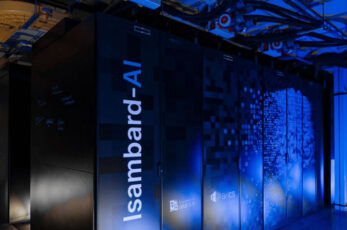
The site is also home to Isambard-AI, a new, national £225 million Artificial Intelligence Research Resource, due to become the UK’s fastest and most powerful supercomputer, and led by the University of Bristol.
The new system has more than six times the computational performance and energy efficiency of Isambard 2, which was used by the Met Office to evaluate the performance of weather forecasting and climate prediction modelling. The supercomputer was powered down last month.
Research conducted on Isambard was also vital in the fight against Covid-19, contributing to the development of vaccines by helping scientists understand how they would interact with the virus.
Isambard 3 will expand on these capabilities, providing researchers across the UK, and their international collaborators, with access to cutting-edge technology that delivers a transformational increase in performance and energy efficiency.
Professor Simon McIntosh-Smith, director of the Bristol Centre for Supercomputing at the University of Bristol, and principle investigator for the Isambard supercomputers, said: “Our work across GW4 Isambard 1 & 2 has already pushed the boundaries of scientific research, and we have enabled significant developments across areas such as sustainable net zero, green energy and healthcare.
“With its advanced capabilities, Isambard 3 will take this research to the next level, supporting collaborations with our academic and industrial partners all over the world, and accelerating our understanding in areas such as artificial intelligence and scientific simulations.”


Bristol University among best for producing business leaders
Read more30.04.2026
New director of innovation appointed at the University of Bristol
Read more15.01.2026
Bayeux Tapestry was mealtime reading for medieval monks, claims Bristol professor
Read more16.12.2025
University of Bristol launches 12 social venture spinouts
Read more01.12.2025
Bristol University to develop ‘British Library’ for the AI age
Read more24.11.2025
Student startups turn £50k into £3.8 million
Read more16.10.2025
UK’s most powerful supercomputer launches in Bristol
Read more28.07.2025
Students’ AI football footage innovation wins share of £72,000 startup funding
Read more10.04.2025