

Swindon & Wiltshire News

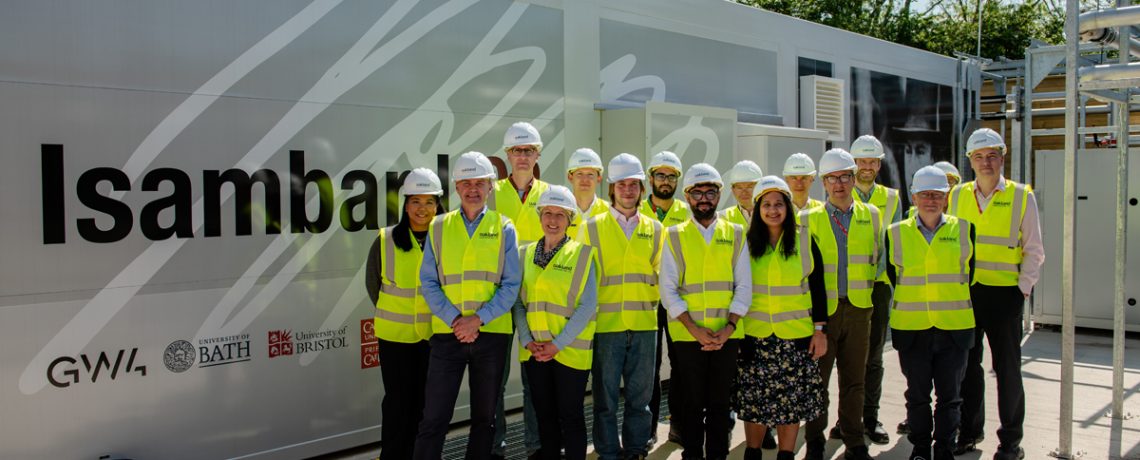
Bristol academics switch on UK’s most powerful supercomputer
The UK’s fastest and most powerful supercomputer – which is ten times faster than the previous UK record holder – has been switched on at the University of Bristol.
And in true Bristol fashion, the £ multimillion Isambard-AI also boasts awesome eco credentials – becoming the second greenest supercomputer in the world, according to the official source – the Green 500.
Bristol University says scientists will soon be able to use the world-class equipment for research that has not been possible in the UK until now, with organisations such as the UK’s AI Safety Institute expected to be amongst the first to harness its capabilities for AI research from this month.
The new Bristol Isambard-AI facility will be used by a wide range of organisations from across the UK to utilise the power of AI, which is already propelling emerging technologies such as training large language models, healthcare and robotics. The supercomputer will also play an essential role in critical areas such as AI safety, accelerating automated drug discovery and climate research.
Hewlett Packard Enterprise has built and delivered the new system with next-generation HPE Cray EX supercomputers and over 5,000 state-of-the-art NVIDIA GH200 Superchips. Funding came from the UK government last autumn in the form of a £225 million investment.
‘Isambard-AI positions Bristol as a vital cog in global technological discovery’
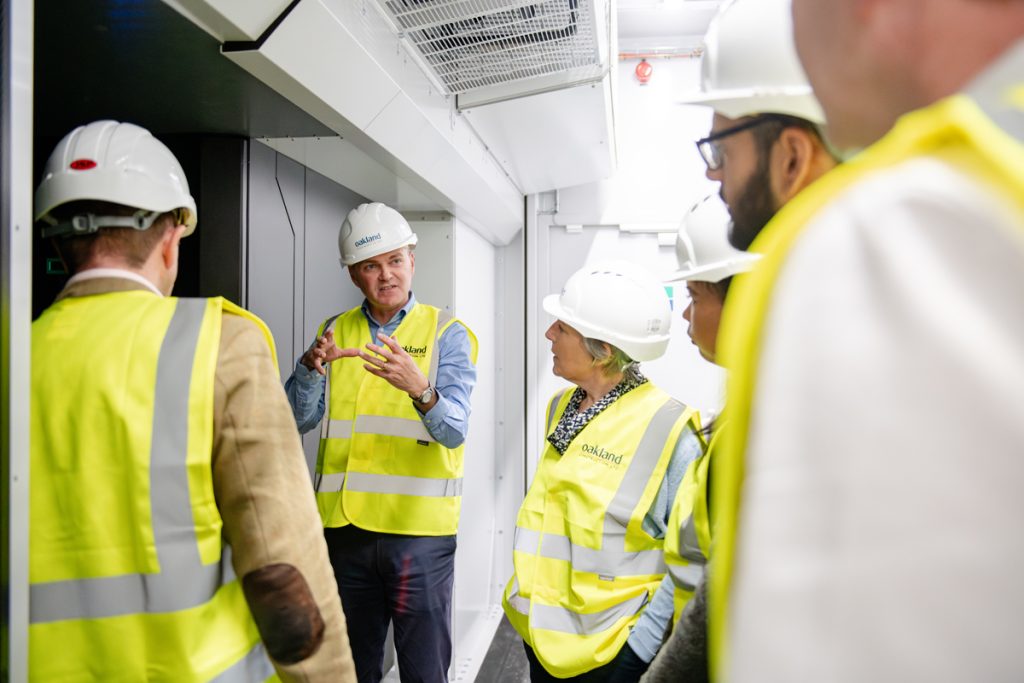
Professor Simon McIntosh-Smith with delegation inside Isambard-3
University of Bristol’s vice-chancellor and president professor Evelyn Welch said: “With Isambard-AI phase one turned on, and primed for action later this month, we welcome this huge step forward towards providing UK researchers with world-class AI and HPC resources, until now accessible by few.
“This will equip the UK with the means to drive the next wave of scientific breakthroughs and positions Bristol as a vital cog in global technological discovery that will improve people’s lives.”
“Isambard-AI phase one’s performance is around 7.4 PFLOP/s on the TOP500 – meaning the 168 GPUs can perform 7.4×10^15 operations per second, while for AI the performance is even more impressive, at 647 PFLOP/s of 8-bit floating point (647×10^15),” said the University.
Need that in English?
Professor Simon McIntosh-Smith, director of the Bristol Centre for Supercomputing at the University of Bristol, explained: “Assuming there are eight billion people on earth, and everyone performed one calculation per second, it would take 2.3 years for all eight billion people, working 24/7, 365-days a year, to do what Isambard-AI phase one could do in one second.”
Pictured: Professor Simon McIntosh-Smith (second right) with a delegation from DSIT, UKRI and University of Cambridge
Latest: AI chipmaker Graphcore acquired by Japanese investor
Latest: University of Bristol crowned AI University of the Year
Latest: Bristol will ‘lead the UK in becoming an AI superpower’




Bristol Uni named best in south west
Read more21.09.2026
Giant pollen grain comes to Bristol as part of Uni celebrations
Read more15.09.2026
University of Bristol climbs to sixth in national league table
Read more21.08.2026
University of Bristol researchers turn ideas into winning innovations
Read more17.06.2026
Bristol University among best for producing business leaders
Read more30.04.2026
New director of innovation appointed at the University of Bristol
Read more15.01.2026
Bayeux Tapestry was mealtime reading for medieval monks, claims Bristol professor
Read more16.12.2025
University of Bristol launches 12 social venture spinouts
Read more01.12.2025