
Swindon & Wiltshire News
Bristol businesses come together to create home ready for life on Mars
Businesses in Bristol have come together to turn the vision of a Martian House into reality.
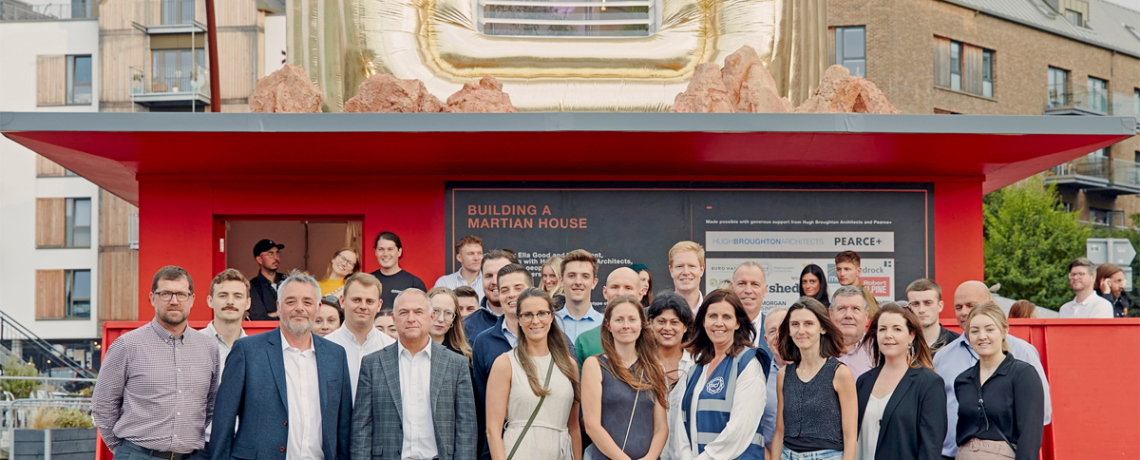
A two-storey house designed for future life on Mars has landed on M Shed Square in Bristol, UK as part of ongoing public art project, Building a Martian House.
The brainchild of local artists and Watershed Pervasive Media Studio residents Ella Good and Nicki Kent, the project has been designed over several years and brought together space scientists, world-renowned architects, engineers, designers, school children and the public, to explore how considering future life on Mars – a planet with low power, zero emissions and zero waste – can inspire us to think creatively about how we can live more sustainably on earth and reassess our relationship with consumerism.
A team led by Hugh Broughton Architects – world experts in creating buildings for extreme environments including the Halley VI British Antarctic Research Station, working in partnership with design studio Pearce+ – developed the design of the house.
The design team worked alongside space science and engineering experts Professor Lucy Berthoud, Dr Robert Myhill and Professor James Norman from the University of Bristol.
And a cohort of construction companies led by BAM, Galliford Try, ISG, Kier, Morgan Sindall, Sir Robert McAlpine, Southern Construction Framework, Wates and Willmott Dixon donated time, expertise and resources worth an estimated £170,000 to bring the art project to life.
The two-storey 53sqm house is powered by solar panels and designed to be lightweight and withstand the environmental challenges that would be faced on Mars – such as average temperatures of -63 degree Centigrade and exposure to galactic and cosmic radiation. The upper level is made from a pressurised inflatable gold-coated foil created by specialists Inflate.
On Mars the walls would be filled with Martian regolith soil. However this prototype is filled with air, so it can be reused. It sits on the Martian landscape and contains a hydroponic living room where occupants are surrounded by plants to aid relaxation and support a healthy diet.
The lower level is designed to be built underground within the lava tubes that exist beneath the planetary surface. As Mars has a thin atmosphere this will protect the inhabitants from high levels of radiation. The lower level of the prototype is surrounded by a hoarding with details about the project and illustrations by artist Andy Council.
This level contains the environmental control room with all the life support systems powering the house, two compact bedroom ‘pods’; along with a shower and a ‘Martian loo’ with low water use, designed by Duravit, prize winners in the NASA Lunar Loo competition. The interior design will be developed with a group of volunteers and will come to life over the lifespan of the project; everything from furniture to the smaller essentials of everyday living like Martian clothes, toothbrush and wallpaper, with a focus on creating items that are easy to repair, are multi-functional and contribute zero waste.
The house will open for public viewings of the lower ground floor every Wednesday and Saturday from 31 August – 16 October. Ahead of that date between 17- 31 August 2022, families are invited to attend a series of drop-in workshops, led by Spacewear fashion and textiles artist Anurita Chandola where they can learn to create textiles and clothes using simple materials that might be available in an off-world settlement like Mars.
Ella Good and Nicki Kent said: “This project is a place for research and experiments about the future.
“Using Mars as a lens because of its resource-limited nature helps focus our conversations around what we need and how we want to live.
“We’re really excited for the public to come along and see some of the research that’s happening in the house – as well as coming on a viewing to see what we’re making for the interiors, there are special opportunities to come to workshops with other artists around hydroponics and textiles.
“We hope everyone finds something they are interested in – the aim is to spark conversations that go beyond the project, rather than providing all the answers.”
Hugh Broughton, director of Hugh Broughton Architects, said: “This is the first Martian House to receive a building consent and it is so exciting to see it built in Bristol.
“The design draws upon principles developed for extreme environments on earth overlayed with solutions to the logistic and environmental challenges of building on Mars, which we have developed with the help of space scientists.
“It is a prototype, intended to challenge people’s perceptions of what life on Mars might be like and to provide a canvas for them to suggest their own ideas to make the house as comfortable and welcoming as possible.
“It has been a triumph of collaboration with so many specialists, designers, engineers and builders giving their time for free, demonstrating what can be achieved with a collective will and effort.
“The project provides an alternative approach to space design which represents the interests of everyone, not just governments and the super-rich.”
Emma Bull, senior framework manager at Southern Construction Framework, said: “It’s fair to say we’re all very proud of the Martian House project, and I’m on Cloud Nine seeing the building form over the last few weeks after over a year of development and coordination.
“Collaboration is at the heart of everything Southern Construction Framework does, so we’re all delighted to have played a role in creating the truly extraordinary Martian House by bringing together leading contractors.
“The way the companies in Southern Construction Framework’s supply chain have collaborated is also extraordinary and for nine separate bodies to come together on an artistic project appears to be unprecedented.
“Working together and throwing their weight behind the Martian House project, speaks volumes about our partners’ commitment to unite in support of the communities where they work and make a positive difference to public spaces.”