
Swindon & Wiltshire News
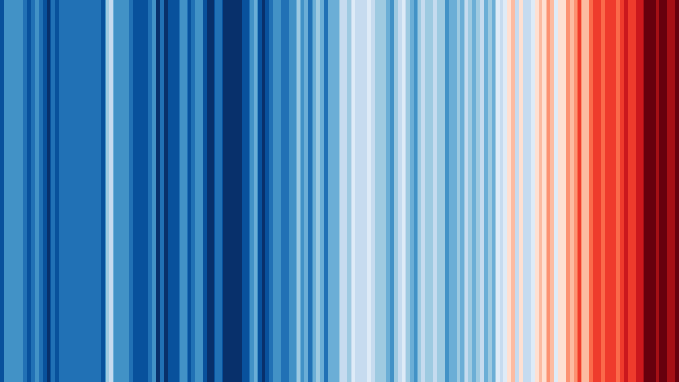
2023 so hot Climate Stripes project needed a new colour to portray it
Global temperatures in 2023 were so hot that the Reading University-based Climate Stripes project has had to create a new colour to portray it.
Professor Ed Hawkins, a climate scientist at the University of Reading’s National Centre for Atmospheric Science has published the first updated climate stripes image for the globe using the latest interim data for 2023.
Due to record temperatures in 2023, the stripe representing 2023 will require the darkest red colour from the current scale.
But when 2023 is confirmed as the warmest global year on record by a wide margin the darkest shade of red will not tell the full story, Professor Hawkins said.
“The colours used in the climate stripes are based on a scale designed to show which years are warmer and cooler than the average,” Professor Hawkins said.
“2023 was off the end of the scale.”
He added: “This was always going to happen at some point, given the continued increase in global greenhouse gases, and is in line with what scientists have been predicting for decades. But the margin of record-breaking in 2023 has still been a surprise.
“The climate stripes are all about starting conversations about climate change, and 2024 has to be the year we turn conversations into faster action.
“The good news is that we already have many of the solutions we need. We now need bold, transformative change across all parts of society to make our planet’s climate safer for current and future generations.”
The new image comes as the Met Office yesterday (Tuesday) confirmed 2023 as the hottest year on record for Wales and Northern Ireland and the second warmest on record for the UK as a whole, just behind 2022.
The climate stripes show the change in average annual global temperatures since 1850. Red stripes indicate hotter years and blue stripes indicate cooler years, against the average of the period 1971-2000.
The stripes represent billions of pieces of scientific data, collected over more than a century, in a single striking image. It is now widely recognised as an iconic emblem for the impacts of climate change.
The stripes have been seen at the United Nations, featured on the cover of a book by Greta Thunberg, appeared on stage at Glastonbury and Reading Festival, and on the catwalk at London Fashion Week.
Latest: Bath and Bristol Universities among best in UK, with Reading the most sustainable, says Sunday Times
Latest: Berkshire-born climate stripes feature in New York design icons exhibition



Berkshire-born climate stripes feature in New York design icons exhibition
Read more16.01.2025
University of Reading named #1 for studying business
Read more19.09.2024
Beard kicks off work on new Shinfield sports facility with the University of Reading
Read more01.03.2024
University of Reading makes £1 billion contribution to economy, study finds
Read more30.11.2023
University of Reading climbs to 169th in QS world rankings
Read more28.06.2023